

Housing Ombudsman cyber incident
The Housing Ombudsman incident has put a public-service dependency under scrutiny: what happens when a supplier-operated system becomes unavailable and the organisation using it still needs to support people?
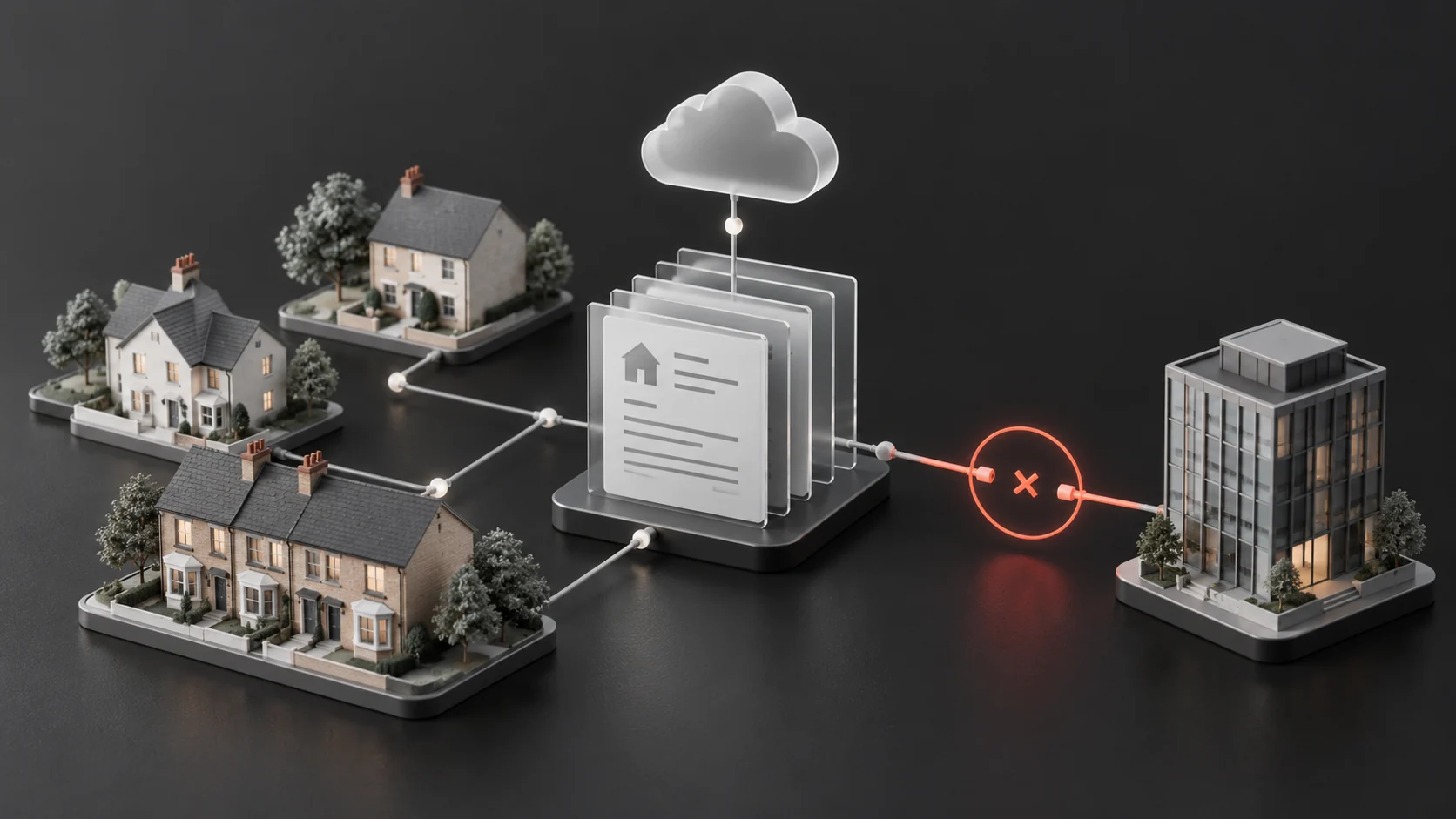
AI-generated editorial illustration of housing, digital records and a disrupted supplier connection. It does not depict the actual incident or its technical cause.
What is confirmed so far
A parliamentary update published on 29 October makes this a current UK cyber story. It does not establish that the attack happened today, or that this was the last attack to occur anywhere in the UK. This article separates the public record from our analysis and practical recommendations.
The Housing Ombudsman’s statement, published on 13 October and updated on 16 October, describes an investigation into unauthorised access involving its third-party case-management system. The service says the incident was contained, the system was taken offline, technical specialists were engaged and the matter was reported to the Information Commission. The scope of any affected personal information remained under investigation in that statement.
- 13 October: the service publicly disclosed the incident.
- 16 October: its statement carried an updated investigation and precautionary-advice notice.
- 27 October: the Commons Housing, Communities and Local Government Committee wrote to the interim Ombudsman.
- 29 October: the committee published news of its intervention.
These are disclosure and oversight dates. They do not establish when the intrusion began. The committee’s letter specifically asks for that chronology.
The immediate impact is access to a service
At the time of our check, the Ombudsman’s homepage service notice said people could not submit new complaints online, view existing complaints, or use web chat, the webform, Learning Hub or landlord portal. It directed new complaints to email or telephone while work continued to restore services.
That operational impact deserves attention even before the data investigation concludes. A complaints system is part of the route through which people seek help. An unavailable portal creates a practical problem: how does someone provide evidence, obtain an update or know their request has been recorded?
Our assessment is that continuity planning should follow the person’s journey through the service. A working alternative channel needs sufficient staff capacity, reliable record keeping and a way to reconcile temporary records when the main platform returns. Simply publishing a telephone number does not demonstrate that the replacement process can handle demand.
The questions that remain unanswered
The public sources reviewed do not establish the initial access method, an identified attacker, a confirmed ransomware deployment, a ransom demand or a verified total of affected people. They do not provide a final account of which records were accessed, copied or published. It would be premature to label the incident an AI-driven attack or attribute it to a particular group.
The committee’s nine questions seek details about timing, affected people and case periods, data types, origin and intent, possible online publication, support for individuals, supplier due diligence and delays to investigations. It requested a reply by 10 November 2026. Those questions are requests for evidence; they are not findings that each possible harm occurred.
We have not assessed private systems, inspected exposed records or conducted forensic work. “Not publicly established” also does not mean “did not happen”. It means the available evidence does not support a firmer conclusion.
Why third-party risk reaches beyond procurement
A supplier-operated platform can hold the working history of an organisation: identities, attachments, decisions, correspondence and permissions. The organisation may depend on that platform for both the information and the process needed to serve its users.
This creates two separate planning questions. Can unauthorised access be prevented or limited? Can the service continue if the platform must be isolated? Strong answers to the first question do not automatically answer the second.
The NCSC’s supply-chain principles organise assurance around understanding risk, establishing control, checking arrangements and continuous improvement. Our interpretation is that supplier review should remain an operational activity throughout a contract, with evidence that changes when the service, data or supplier chain changes.
A certificate or completed questionnaire can inform a decision. It cannot, by itself, show whether the exact service you use can recover its records, preserve access history or support your users during an outage.
Six questions to take to your critical suppliers
The following is IntelliCreate’s practical review framework, informed by the NCSC guidance. It is not a finding about controls at the Housing Ombudsman or its supplier.
- What exactly depends on this supplier? Map the service, the information it holds, integrations and subcontractors. Identify which people and decisions stop if it goes offline. The NCSC’s risk-understanding guidance starts with knowing what must be protected and how the supply chain works.
- Who can reach the data? Ask for the current access model, privileged roles and process for removing obsolete access. Where supplier systems connect to yours, the NCSC recommends limited, controlled and monitored access, with least privilege and appropriate separation. Read the control guidance.
- How will we learn about an incident? Specify a named contact, a route that works if normal email is unavailable, escalation responsibilities and expected reporting times. Ask how uncertainty will be communicated while the investigation develops.
- What evidence will be available? Agree which logs can show access to records, changes and exports, who preserves them and how quickly they can be provided. Test whether those records answer real investigation questions.
- Can we restore the service, not just files? Ask for evidence from a recent recovery exercise: what was restored, how long it took, what information was missing and who accepted the result. Set recovery expectations around the business process.
- How do we check the answers? Establish proportionate assurance and review arrangements. The NCSC’s guidance on checking arrangements treats confidence in supplier controls as something to verify. Record shortcomings with an owner and a realistic remediation date.
A response plan should survive the loss of the main platform
The NCSC’s Small Business Guide to Response and Recovery covers preparation, identifying the incident, resolution, stakeholder reporting and learning. DSIT’s incident-response guidance for connected places similarly describes a cycle of preparation, response, recovery and review, and recommends realistic testing.
For a team reviewing its own readiness, we suggest a short exercise: assume your case-management or customer platform is inaccessible tomorrow morning. Then work through these decisions:
- Ownership: who leads the response, approves containment and keeps a record of decisions?
- Evidence: how will specialists preserve relevant records before recovery work changes the environment?
- Continuity: what minimum service can you operate safely, and which urgent requests receive priority?
- Communication: who updates users, staff and partners, through which trusted channel, and when is the next update due?
- Restoration: what technical and operational checks must pass before reconnection, and who authorises it?
Measure the exercise by completed decisions and working alternatives. A plan that requires access to the failed platform to find the supplier’s emergency contact has already exposed a useful gap.
Practical steps for residents and other service users
Use the Housing Ombudsman’s own current service notice for contact routes and availability. Its incident notice advises caution with unexpected communications and lists DPO@housing-ombudsman.org.uk for data-protection concerns.
If an unsolicited message mentions your complaint, a familiar name or reference number is not sufficient proof of identity. Open the organisation’s website independently and verify the request through a published contact route. Avoid sending additional identity documents or financial details in response to an unexpected message.
GOV.UK’s reporting guidance says suspicious emails can be forwarded to report@phishing.gov.uk and suspicious texts to 7726. Do not click an uncertain link or download an unexpected attachment to investigate it yourself.
If you have already disclosed banking details or transferred money, contact your bank promptly through a trusted route. Keep relevant messages and a record of what happened so the organisation or authorities can understand the sequence.
Where AI belongs in this discussion
There is no basis in the reviewed public record to assign AI a role in causing this incident. Nor would adding an AI tool, by itself, resolve supplier governance or continuity problems.
For organisations evaluating defensive AI, our recommendation is to start with a defined task, such as helping an analyst prioritise unusual access events. Compare it with the existing process using representative data. Measure missed events, false alarms, time saved and the quality of the evidence retained. Keep consequential access or containment decisions subject to appropriate human control.
A useful system must also explain its limits. An alert about unusual activity is a reason to investigate; it is not proof of who acted or which records were taken. That distinction matters when technical findings become public statements.
What to watch next
The most useful next developments would be a clearer incident chronology, an evidence-based account of the data impact, support arrangements for affected individuals and a tested restoration plan. Readers should look for official investigation updates and the committee’s published correspondence rather than treating an unverified attacker claim as confirmation.
For other UK organisations, the immediate task is concrete: identify one critical supplier, trace the service dependency and rehearse operating without it. The result should be a named owner, an evidenced control or recovery gap, and a decision about how that gap will be addressed.
Sources and research method
This is independent IntelliCreate reporting and analysis based on public primary sources checked on 29 October 2026. We prioritised statements from the affected service, parliamentary correspondence and UK public-sector security guidance. Recommendations are our synthesis; they do not imply that a particular missing control caused this incident. The account may change as evidence emerges.
- Housing Ombudsman incident statement: published 13 October; page updated 16 October 2026.
- Housing Ombudsman live service notice: availability and temporary contact arrangements.
- House of Commons committee update: 29 October 2026.
- Committee letter to the interim Housing Ombudsman (PDF): 27 October 2026.
- NCSC supply-chain security principles and linked risk, control and assurance guidance.
- NCSC Small Business Guide: Response and Recovery.
- DSIT connected-places incident-response guidance.
- GOV.UK guidance on reporting suspicious communications.